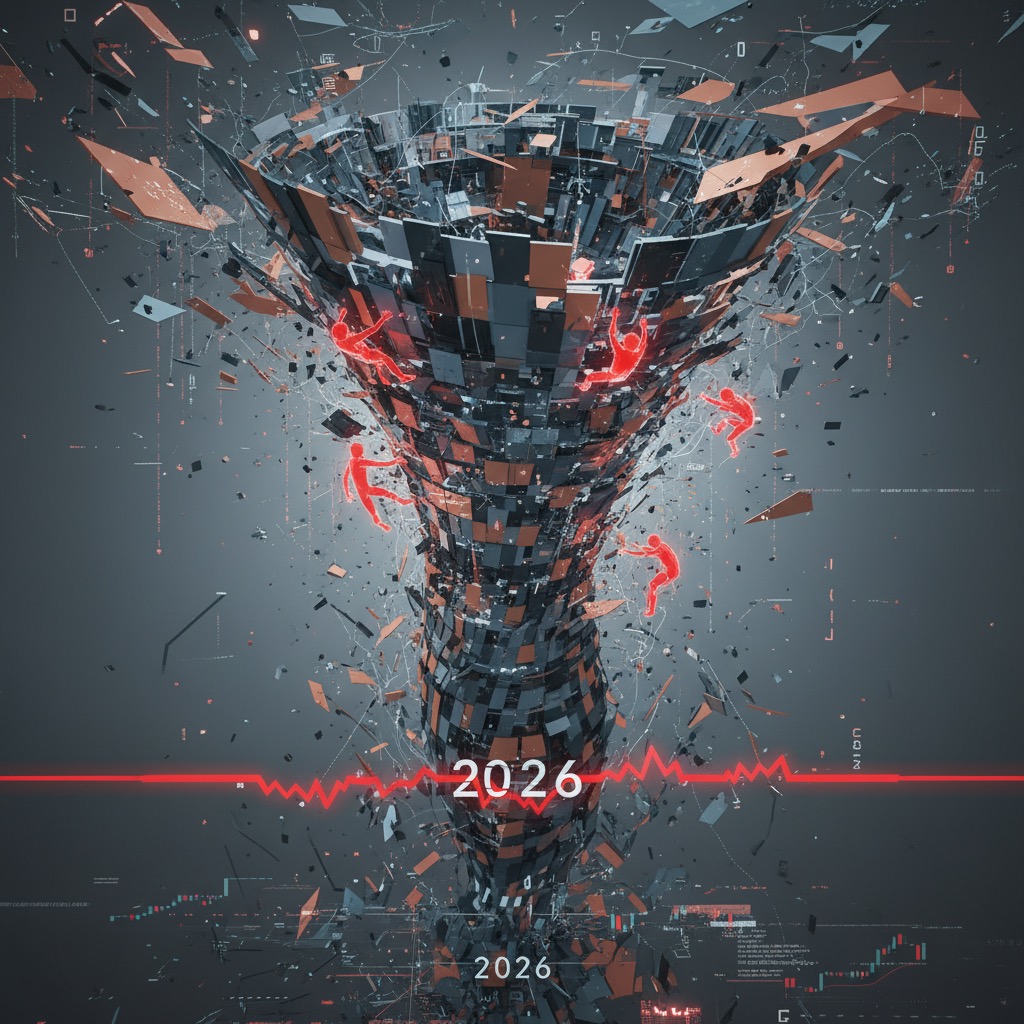
The 2026 Tipping Point: Why the "Decade of Agents" Will Cause a Corporate Collapse (And How to Survive It)
The 2026 Tipping Point: Why the "Decade of Agents" Will Cause a Corporate Collapse (And How to Survive It)
Executive Summary:
We stand at a deceptive calm before a structural hurricane. While AI demos dazzle and investment soars, the real economic impact remains muted—yet 2026 is forecasted to be the year this tension snaps. Based on insights from leading AI researchers and recent GDPval benchmark data, this post synthesizes why knowledge work is "cooked," why corporations face existential collapse, and the radical reset required to survive.
The Situation: The "Cooked" Economy
We are currently living through a strange paradox. On one hand, we see breathtaking demos where AI writes code and answers complex questions instantly. On the other hand, the actual economic impact feels surprisingly muted in our daily lives. Ilya Sutskever captures this feeling perfectly, noting, "It's crazy how normal the slow takeoff feels," and that despite massive investments, "it's not really felt in any other way so far."
However, this calm is deceptive. According to recent forecasts, 2026 will be the year this tension snaps. Salim Ismail, speaking on the Moonshots Podcast, predicts that "2026 is going to see the biggest collapse of the corporate world in the history of business."
The forecast for 2026 is defined by a massive leap in capability that traditional structures are not ready for. Recent data from OpenAI's GDPval benchmark—which measures AI performance on economically valuable, real-world tasks—reveals that frontier models now match or exceed human experts on 71% of knowledge work tasks, completing them at "more than 11 times the speed" and "less than 1% of the cost." As Alex (AWG) concluded on the Moonshots Podcast, "Knowledge work is cooked."
The GDPval Wake-Up Call
OpenAI's GDPval evaluation, introduced in September 2025, represents a methodological breakthrough. Unlike traditional academic benchmarks, it measures performance across 44 occupations spanning nine major economic sectors that collectively contribute $3 trillion annually to U.S. GDP. The results are stark:
- 71% automation rate: AI outperforms human professionals in 71% of task comparisons
- 100x cost reduction: Frontier models work at less than 1% of human professional cost
- 11x speed advantage: Tasks that take humans 7 hours on average are completed in minutes
The benchmark covers everything from legal briefs and engineering blueprints to nursing care plans and financial analyses—real deliverables, graded blind by industry experts.
The Layoff Wave Has Already Begun
This shift has consequences. The Moonshots team discusses a scenario where 2025 sees "1.1 million layoffs," the highest since the pandemic, as companies begin to shed headcount in favor of digital labor. These aren't just predictions—they're early signals. The "great resignation" is being replaced by the "great replacement."
The "Decade of Agents" Reality Check
While some see immediate disruption, Andrej Karpathy frames this on the Dwarkesh Patel Podcast as the "decade of agents," not just the "year of agents." We are moving from simple chatbots to entities that act like employees, though the transition is harder than it looks. As Karpathy explains, "When you're talking about an agent, you should think of it almost like an employee or an intern that you would hire to work with you."
The Complication: The "Intern" Paradox
If AI is so fast and cheap, why haven't companies fully switched yet? The complication is that current AI models suffer from a "Reliability Gap"—the difference between a demo and a product.
1. The "Intern" Reality
Karpathy argues we should view current agents "almost like an employee or an intern." You wouldn't trust an intern with mission-critical autonomy because "they lack continual learning" and often make mistakes when unsupervised. He notes that agents are currently "cognitively lacking" and struggle when they go "off the data manifold"—meaning they fail when encountering unique situations not found on the internet.
This isn't just theoretical. As one AI practitioner described on the AnswerRocket blog, "The technology delivering huge productivity boosts today doesn't need to wait for full autonomy. The ROI is available right now for well-understood business processes." But that ROI comes with supervision.
2. "Unreliable Generalization" and the Savant Problem
Ilya Sutskever deepens this on the Dwarkesh Patel Podcast, describing what he calls the "savant" problem. He compares current models to a student who practiced 10,000 hours specifically for a competitive programming contest. They can solve the test problems perfectly, but they lack the broader "it" factor or judgment required for a general career.
Sutskever describes the "vibe coding" loop of frustration: You ask a model to fix a bug, "and it introduces a second bug. Then you tell it... 'You have this new second bug,' and it tells you... 'Oh my God, how could I have done it?' and brings back the first bug."
This "brittle intelligence"—as detailed in The AI Corner's analysis—reveals why AI aces benchmarks but fails at simple logic. The models are Student A (the memorizer) when we need Student B (the intuitive generalizer).
3. The "March of Nines"
Karpathy compares this to self-driving cars. A demo might work 90% of the time, but getting to 99.999% reliability is a brutal "march of nines." Each "nine" of reliability requires exponential effort. Corporate adoption is stuck because companies are waiting for that last mile of reliability, which takes longer than expected.
As Karpathy explains: "Every single nine is a constant amount of work. When you get a demo that works 90% of the time, that's just the first nine. Then you need the second nine, a third nine, a fourth nine, a fifth nine." Waymo gave perfect demo rides in 2014—yet widespread deployment remains uneconomical in 2025.
The Key Problems: Paralysis and The "Sheep Effect"
The collapse predicted for 2026 will be driven by structural and psychological failures in the business world.
The Legacy Stack Trap
Dave on Moonshots points out that companies are failing because they are trying to force AI into legacy systems (like Java monoliths) where the models struggle. He notes that if a company scraps the old system and rebuilds "entirely from scratch in Python," the AI "immediately crush[es] the problem."
This creates a catch-22: Legacy systems can't leverage AI effectively, but ripping them out requires capital and courage that most organizations lack.
Corporate Paralysis
Salim Ismail observes that large companies are "paralyzed" and "flailing." Instead of adapting, they hire traditional consultants who push them down the old path, or executives simply choose to retire rather than navigate the shift.
As Richard Singer noted in his LinkedIn analysis of the Moonshots episode, organizations have "immune systems" that reject change. The bigger the threat, the stronger the resistance—a death spiral.
The "Sheep Effect"
Dave predicts that adoption will start slowly due to this paralysis, but "the sheep effect flips in 2026." Once a few early adopters see their stock prices jump 10x, boards of directors will panic, asking "What about us?" This will trigger a chaotic, desperate rush to adopt AI that many companies will not survive.
The "sheep effect" describes how corporate herd behavior amplifies both delay and panic. Companies wait until it's too late, then overcorrect catastrophically.
The Likely Solution: A Radical Reset
How do companies survive the 2026 transition? The sources point toward a complete restructuring of how we integrate AI.
1. Build "AI-Native" at the Edge
Salim Ismail advises that you cannot fix the legacy core directly. Instead, companies must "create a new stack on the edge that's completely built AI native from the ground up" and slowly migrate functionality over. You don't automate the old human workflow; you "re-transform" the workflow entirely.
This means:
- Starting greenfield projects in Python with AI-first architecture
- Using AI not as a bolt-on but as the foundation
- Migrating functionality piece by piece from the old system
2. Forward-Deployed Talent
Dave highlights a massive opportunity for "forward deployed" engineers. Because legacy companies (like banks or retailers) cannot hire top AI talent directly, they will need to hire consultancies that embed young, AI-native engineers into their organizations. He suggests startups should "hire those 20,000 people" let go by big tech and "get them embedded back into corporate America" to build these new systems.
This creates a new model: AI-native SWAT teams that parachute into legacy organizations and build the future from within.
3. The "Teenager" Learning Model
Technologically, Ilya Sutskever suggests we must move past simple training to models that learn like a "teenager learning to drive." Rather than needing a verifiable reward for every step, future models will use a "value function" to self-correct and learn from experience, achieving the robust reliability humans have.
Sutskever's vision for Safe Superintelligence centers on this: not an all-knowing oracle, but a superintelligent 15-year-old that can learn any job extremely fast.
4. Human-in-the-Loop Supervision
Until that reliability is achieved, Karpathy suggests the winning model is "teams of five AIs" supervised by humans. He predicts we won't instantly replace people but will "swap in AIs that do 80% of the volume" while humans handle the last, difficult 20%.
This hybrid model is already emerging. As the Marketing AI Institute reported, realistic productivity gains range from 1.12-1.39x when accounting for human review time—still substantial, but not the 100x promised by pure automation.
The Verdict for 2026
The future is not about AI magically fixing old businesses. As Salim Ismail warns, "Digital transformation... is officially dead," replaced by "AI native rewrites." The companies that survive 2026 will be those that stop treating AI as a software update and start treating it as a new kind of employee that requires a completely new kind of organization.
The winners will be:
- Startups that build AI-native from day one
- Legacy companies that create parallel AI-native stacks
- Forward-deployed consultancies that bridge the talent gap
- Individuals who learn to orchestrate teams of AIs
The losers will be those waiting for perfect AI, those trying to retrofit AI into broken processes, and those who underestimate the "march of nines."
Call to Action: Start Today, Not Tomorrow
The most dangerous misconception is that you have time. As Jim Johnson wrote in AnswerRocket, "Karpathy's timeline isn't a reason to delay. It's a wake-up call. The question is whether you'll spend the next decade capturing value or watching your competitors pull ahead."
Your immediate moves:
- Audit your workflows: Which tasks are repetitive and pattern-based? Start there.
- Build a parallel stack: Don't fix the legacy core. Build AI-native at the edge.
- Hunt forward-deployed talent: Find those 20,000 AI-native engineers.
- Embrace the 80/20: Let AI handle volume; humans handle exceptions.
- Start the march of nines: Every nine of reliability you achieve now compounds.
The 2026 collapse won't be sudden—it will be a slow rot masked by inertia, until the sheep effect flips. Contracts, renewals, and customer loyalty will mask decline for years. But once quarterly results wobble, shareholder pressure will force decisions that leaders avoided when there was still cover.
By then, transformation isn't strategic—it's reactive. And reactive transformation is just controlled collapse.
Additional Resources:
- OpenAI GDPval Benchmark Paper
- Andrej Karpathy on the Decade of Agents
- Moonshots Podcast: GPT 5.2 & Corporate Collapse
- Ilya Sutskever on the End of Scaling
This post synthesizes insights from leading AI researchers, recent benchmark data, and industry analysis. The predictions represent expert opinions, not certainties. The future belongs to those who prepare for multiple scenarios.